Friday, January 28, 2011

In Science Class . . . Week of 1/24

This week in science, we've continued our learning about how plants make energy (and gain mass) and how other organisms use that energy. We did an experiment with yeast. By giving the yeast sugar (in the form of crumbled up Chips Ahoy cookies), they became active and started cellular respiration. This process produces carbon dioxide as a waste product, which caused our bags of yeast and warm water to puff up! We used a tool to measure that gas produced as well as the amount of gas produced by the control experiment (no cookies), which was zero in most cases.
Key questions to ask your student:
  • What organisms make their own energy? How can we tell that they are making energy? (Gain mass, grow)
  • In the experiment with yeast, how did we know that the yeast were burning sugar? (They produced carbon dioxide as a waste product)
  • Can you think of other organisms that produce carbon dioxide as a waste product of cellular respiration? (Most animals, including humans!)

Friday, January 21, 2011

In Science Class . . . Week of 1/17

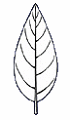
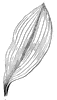
The 4th and 5th graders have been wrapping up our study of vascular plant systems. We watched a video on plant structure and growth earlier this week, and yesterday, we studied different vein patterns in leaves we found around the school yard. Thanks to the huge wind storm, there were a ton of great options around! Here are some examples:

Palmate:
Pinnate:


Parallel:


Key Questions:
  • How do vascular plants get water and sugar to cells? (Xylem transports water up from the roots, while phloem transports it downward to other cells. Both xylem and phloem are part of "veins" that we see on leaves.)
  • What leaf patterns did you see in your leaves that you collected?

Friday, January 14, 2011

In Science Class . . . Week of 1/10

Hi, everyone! Happy New Year! Apologies for not getting this out to you last week. We had a major power outage during the time I normally update the blog! Anyway, here's what we have been working on:

We've just wrapped up our human body systems and have started looking at the ways plants get energy, water and gas to their cells. This week, we've been experimenting on celery. We set up an experiment to see which type of celery uses more water - celery with leaves or celery without leaves. Students also got to put red food coloring in the water so that we could track the flow of water up the stem and into the leaves. Here are some key questions:
  • What do plant and animal cells have in common? (All need food, water, gas exchange and waste disposal)
  • How do vascular plants transport water? (There are tubes in vascular plants called xylem that bring water from the bottom up into the leaves. These tubes turned red in our celery experiment due to the red water we used.)
  • What would be analogous in the human body to xylem in plants? (Probably our circulatory system of veins and arteries, though we obviously have a heart that pumps it around, while plants depend on evaporation out of the leaves to draw water upwards.)
  • What did you find from your experiment? (Celery with leaves used more water. This is because the evaporation out of the leaves "pulls" water molecules from below. )
Here's a nice cross section photo of what we worked on. This photo also includes some celery where blue food coloring was used. We only used red, but using other colors would be a great at-home project!

Friday, December 10, 2010

In Science Class . . . Week of 12/6

This week, the students have been studying digestion through reading, discussion and a video. Here's a diagram:

Of the structures shown above, students need to know the names and functions of the following:

Teeth: Used for grinding food into smaller bits
Saliva: Made in the mouth and used for wetting food and breaking it down.
Esophogus: Moves food from the mouth to the stomach
Stomach: Contains strong digestive acids for further breaking down food
Small intestine: Most nutrients are absorbed through the wall of the small intestine to the blood stream

For excretion, the students need to know the following structures:
Large intestine (colon): Condenses and dries solid waste
Rectum/anus: Used for excretion of solid waste
Kidneys: Clean blood in preparation for liquid waste excretion
Bladder: Stores liquid waste prior to urination
Lungs: Used to exhale carbon dioxide


Friday, December 3, 2010

In Science Class . . . Week of 11/29

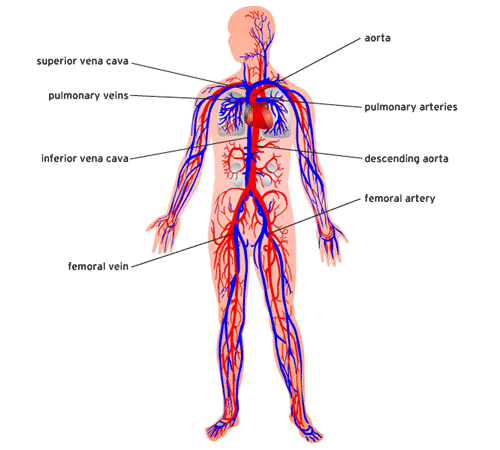
This week, the students have started a new unit on living systems. They learned about cells and circulation through reading, discussion and video. Here is a diagram of the circulatory system:
The students do not need to know all of the names of the various arteries and veins; it is more important that they understand the main ideas:
  • What are cells? (Small units found in all living organisms) 
  • What do cells need to survive? (Water, food, gas exchange, waste disposal)
  • How do many animals, including mammals, get these requirements to the cells? (Through a circulatory system). 
  • What are the key components of human circulatory system? (Blood, heart, arteries, veins and capillaries)
  • How does the body respond to increased cell needs during exercise? (By increasing breathing and heart rate, the circulatory and respiratory systems can get more oxygen to cells).
  • Why do your veins appear blue? (They contain blood that has already "given up" it's oxygen to the cells, so the blood itself is blue. When you cut yourself, the blood immediately gets oxygen from the air, so blood from all cuts is red.)
  • How many chambers does the human heart have? (4. The right two chambers are responsible for pumping deoxygenated blood to the lungs, while the left two chambers are responsible for receiving oxygenated blood from the lungs and pumping it to the body. 
Note for Ms. Carter's class: Our CalTeach student, Ashley, taught about digestion this week, so those students will learn about circulation next week! I'll include questions then about digestion. Sorry for the confusion! Ashley is an undergrad at Cal who has been with the class for the last couple weeks, and she chose to teach about digestion, so there is a little scheduling anomaly - I needed to switch digestion and circulation for this class to meet her scheduling needs. 

Friday, November 19, 2010

Quiz on Tuesday!

We're wrapping up our study of earth science, and will be having a quiz on Tuesday, November 23. The students brought home a study guide yesterday that we completed in class. Please take a few moments to review with your student over the weekend. Thanks!

Friday, November 12, 2010

In Science Class . . . Week of 11/15

This week, we'll officially begin our study of weather and weather maps. For fun, we'll be using our mobile computer lab to go online to study weather maps. We're using the site, www.weather.com, but there are lots of sites out there! A sample weather map looks like this:

Key questions:
  • What symbols did you see on the weather maps, and what do they mean? ( H= high air pressure, L= low air pressure, etc)
  • Why does the California coast have more moderate temperatures than inland? (Because we are near the ocean, and the air over the ocean heats up much more slowly because the ocean itself does not heat up easily). 
  • Where do our storms in Berkeley come from? (Primarily from out over the Pacific Ocean)